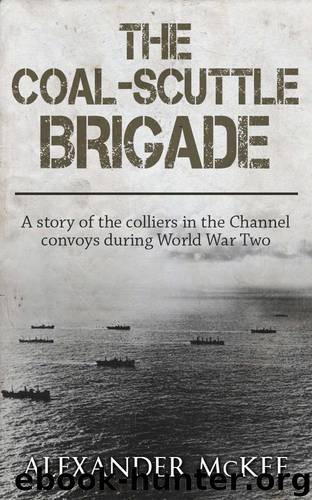
The Coal-Scuttle Brigade by Alexander McKee
Author:Alexander McKee [McKee, Alexander]
Language: eng
Format: azw3
Publisher: Endeavour Press
Published: 2016-05-17T04:00:00+00:00
10 - E-Boat Alley
CAPTAIN POTTS, of the Betswood, stirred restless in his sleep. Blinking, and vaguely uneasy, he glanced out of the port-hole. What he saw there sent him out of his bunk and running in desperate haste for the bridge ladder. He had seen a ship, with the seas breaking over her.
The officer on duty looked round in surprise at the sudden appearance of the master. Potts rapped out:
‘Full astern: Hard-a-starboard,’
The telegraphs rang, and the wheel went over, the Betswood stopping, then going astern and turning, regardless of any confusion to the other ships of convoy F.S. 69, then steaming down the Norfolk coast for London. His desperate action saved the ship, but other masters were not so wide awake; they blindly followed their leaders.
Within a short time there were six merchantmen and an armed trawler of the escort lying stopped, with heavy seas breaking violently over them and rapidly pounding them to pieces. It was this sight, of waves breaking broadside over a ship, which had warned the master of the Betswood. It means only one thing — the ship is aground; and in this area that meant one other thing — the Haisborough Sands, which form the northern entrance to E-boat alley.
There were 171 men in the stranded ships. Nothing could save the ships, they were disintegrating underneath their crews minute by minute; but it might still be possible to save the men. The roar of the waves pounding on that strip of half-submerged sand, lying in a great arc round the curve of the Norfolk coast, was sufficient warning of the peril into which their boats must go.
To this pass they had come, by blindly playing follow-my-leader, not bothering to do their own navigation, as a check, just in case. One after the other, like the mythical soldiers who marched over a cliff on parade formation because no one said ‘Halt!’ they had driven in succession upon the foam-covered sands. And now, in this August gale of 1941, they must soon drown, unless rescue came.
It did come, in the shape of the two Cromer lifeboats under Coxswain Blogg, G.C., and the efforts of the surviving ships of the convoy. But for thirty-seven of them rescue was too late or utterly impossible by reason of the height and fury of the seas, and they drowned that night upon the Haisborough.
In the whole of 1941, 268 ships were sunk or wrecked, not by the enemy, but by the perils of the sea. They totalled 418,164 tons. It was inevitable, for the ships were unnaturally massed and marshalled together, passing at night down narrow treacherous channels where, at first, all navigational signs had been removed. Later, very dim lights, shaded from above, were shown by the buoys — but in a night of driving rain or howling storm, with the vessels shipping it green and spray bursting like hail continually over the bridge, it was not hard to make a fatal error. To these hazards, the perils of the enemy were only additional; though they were serious enough.
Download
This site does not store any files on its server. We only index and link to content provided by other sites. Please contact the content providers to delete copyright contents if any and email us, we'll remove relevant links or contents immediately.
| Africa | Americas |
| Arctic & Antarctica | Asia |
| Australia & Oceania | Europe |
| Middle East | Russia |
| United States | World |
| Ancient Civilizations | Military |
| Historical Study & Educational Resources |
The Radium Girls by Kate Moore(12000)
100 Deadly Skills by Clint Emerson(4898)
Rise and Kill First by Ronen Bergman(4757)
The Templars by Dan Jones(4671)
The Doomsday Machine by Daniel Ellsberg(4472)
The Rape of Nanking by Iris Chang(4188)
Killing England by Bill O'Reilly(3985)
Stalin by Stephen Kotkin(3936)
Hitler in Los Angeles by Steven J. Ross(3934)
12 Strong by Doug Stanton(3537)
Hitler's Monsters by Eric Kurlander(3313)
Blood and Sand by Alex Von Tunzelmann(3179)
The Code Book by Simon Singh(3160)
Darkest Hour by Anthony McCarten(3110)
The Art of War Visualized by Jessica Hagy(2985)
Hitler's Flying Saucers: A Guide to German Flying Discs of the Second World War by Stevens Henry(2736)
Babylon's Ark by Lawrence Anthony(2658)
The Second World Wars by Victor Davis Hanson(2510)
Tobruk by Peter Fitzsimons(2492)
